Core Concepts
This page provides an overview of the core concepts in PettingLLMs.
Multi-Agent Reinforcement Learning
PettingLLMs is built on the principle of multi-agent reinforcement learning where multiple LLM agents collaborate to solve complex tasks.
Key Concepts
Agents: Specialized LLM agents with specific roles (e.g., Planner, Executor, Coder, Tester)
Policies: Neural network policies that control agent behavior. PettingLLMs supports: - Role-sharing policies: Single policy shared across all agents - Role-specialized policies: Separate policies for each agent role
Environments: Task-specific environments that agents interact with: - Game environments (Sudoku, Sokoban) - Planning environments (Plan-Path) - Code environments (APPS, CodeContests) - Math environments (AIME, OlympiadBench)
Trajectories: Sequences of observations, actions, and rewards collected during agent-environment interaction
AT-GRPO Algorithm
AT-GRPO (Agent- and Turn-wise Group Relative Policy Optimization) is the core training algorithm in PettingLLMs.
Key Features
- Agent-wise Grouping: Groups rollouts by agent role for specialized learning
- Turn-wise Grouping: Groups rollouts by conversation turn for temporal learning
- Tree-structured Sampling: Samples multiple trajectories from shared prefixes
- Mixed Rewards: Combines global task rewards with local agent rewards
See AT-GRPO Algorithm for detailed explanation.
Training System Architecture
PettingLLMs uses a distributed training architecture:
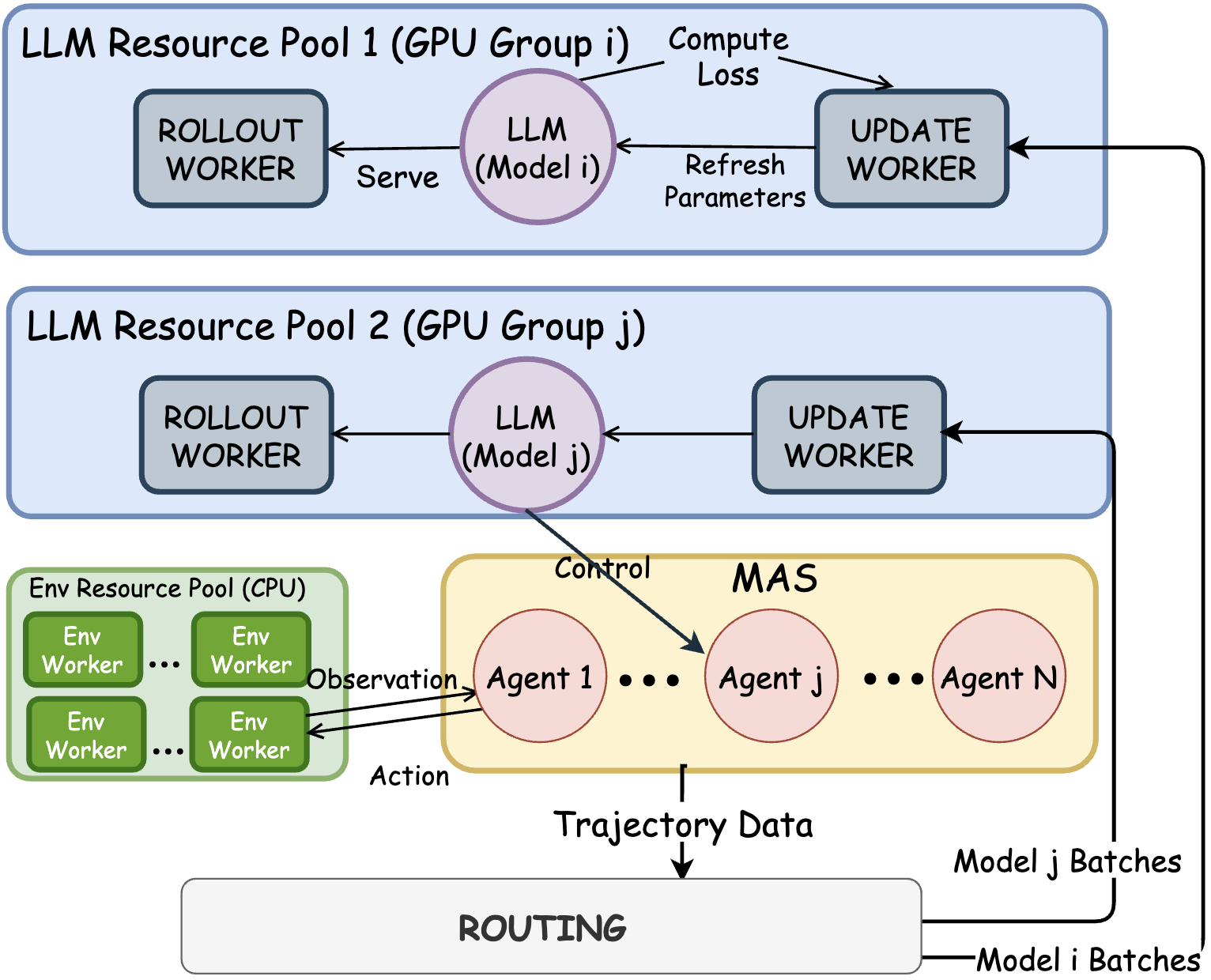
Components
RolloutWorkers: - Run inference to collect trajectories - Pinned to specific GPUs - Refresh policy weights before each rollout - Support batched sampling
UpdateWorkers: - Perform policy optimization - Pinned to separate GPUs - Train on fresh rollout data only - Support gradient accumulation
EnvWorkers: - Run on CPUs - Execute environment logic - Sandbox agent actions - Compute rewards
Router: - Dispatches observations to correct agents - Routes trajectories to appropriate policies - Manages multi-policy coordination
See Training System for detailed architecture.
Multi-Agent Workflows
PettingLLMs implements different agent workflows for different task domains:
Game/Planning Workflow
Code Workflow
Tester → writes/refines tests
    ↓
Coder → implements/refines code
    ↓
Environment → runs tests
    ↓
[Repeat until tests pass or budget]
Math Workflow
Tool Agent → uses calculator/Python
    ↓
Reasoner → produces final answer
    ↓
Environment → verifies answer
    ↓
[Repeat until correct or budget]
See Multi-Agent Workflows for detailed examples.
Training vs. Evaluation
Training (Multi-Agent)
- Multiple specialized agents collaborate
- Turn-by-turn interaction
- Intermediate rewards guide learning
- Terminates on success or turn budget
Policy Types
Role-Sharing Policy
- Single policy controls all agents
- Agents differentiated by system prompts
- Suitable for tasks where roles are similar
- More sample efficient
Role-Specialized Policies
- Separate policy for each agent role
- Each policy fine-tuned for specific role
- Suitable for tasks requiring distinct skills
- Better final performance
Reward Structure
PettingLLMs uses a mixed reward structure:
Global Rewards
- Based on overall task success
- Same reward for all agents
- Encourages coordination
Local Rewards
- Based on individual agent actions
- Different for each agent
- Encourages specialization
Example: Game Task
# Global reward: Test pass rate
global_reward = final env reword

# Local rewards
tool_agent_reward= the action of tool agent execution  reward
plan_agent_reward= the action of plan agent execution reward

# Combined
final_reward = alpha * global_reward + local_reward
Configuration System
PettingLLMs uses a hierarchical configuration system:
pettingllms/config/
├── <task>/
│   ├── single_policy.py    # Role-sharing config
│   └── two_policy.py       # Role-specialized config
└── ppo_trainer/
    └── trainer_config.py   # Trainer config
Each config specifies: - Model architecture - Agent roles and prompts - Environment settings - Reward structure - Training hyperparameters
Next Steps
Dive deeper into core concepts:
- Understand the training algorithm: AT-GRPO Algorithm
- Learn about distributed training: Training System
- Explore agent specialization levels: Three-Level Specialization